
Here are the answers to some Frequently Asked Questions (FAQs) regarding Electromyography (EMG) and Nerve Conductions Studies (NCS), also known as electrodiagnostic (EDX) testing.
EDX testing is useful in evaluating symptoms of numbness, tingling, burning, weakness, muscle twitches, leg cramps, and pain radiating from the neck or low back.
EDX testing will determine if there is abnormal nerve or muscle function, the source of the problem, the severity of injury, the prognosis for recovery, and may guide treatment decisions.
EDX test results can tell us if the problem is limited to an injury of one nerve or due to a more generalized disease process.
For example, numbness in the hands may be commonly caused by carpal tunnel syndrome slowing conduction of the median nerve at the wrists. A pinched nerve in the neck may cause similar symptoms. These two conditions may co-exist with both contributing to the problem at the same time. In turn, each of these conditions is different from a more widespread polyneuropathy, as in a diabetic peripheral neuropathy. In each case, the treatment would vary. Treatment may be focused on resting a particular body region, avoiding stress or strain, or controlling diabetes. EDX testing may be helpful in making the decision to undergo surgery versus pursuing non-surgical options.
You may feel a mild to moderate tingling or electric sensation during nerve conduction studies (NCS) and a slight pinch with needle testing of select muscles during electromyography (EMG).
Tolerance level varies from patient to patient. The test has been performed with ease on patients of all ages, including elderly patients. The providers at Mountain Medical Practice are very concerned about your comfort level and have taken measures to make your EDX testing experience more pleasant. For nerve conduction studies, a low-grade, safe, electrical current is applied to the skin of the limb being tested. The electrical stimulus intensity starts out very low, is initially undetectable, and is then incremented gradually as needed to provoke a sufficient nerve response, and it is adjusted to your tolerance level.
EMG testing is performed using pre-sterilized, pre-packaged, single-use, disposable needles that are very thin and designed to glide easily through skin and muscles with minimal patient discomfort. A topical cooling anesthetic is sometimes sprayed over the skin. Each needle is composed of a metal shaft embedded in an insulating material with a recording electrode at the sharp tip end. The EMG needle used in EDX testing is less invasive than the needle that is typically used to draw blood for routine laboratory tests. There is usually minimal soreness if any at the needle insertion sites that may last a day or two after the test procedure.
Yes, you will actually receive a low-grade and safe electric shock. It is a pulsed direct current (DC). A brief controlled electric pulse is applied to the skin to stimulate a nerve response. The test measures your reaction time, nerve speed, and nerve strength. The low-grade electrical current used during EDX testing is not harmful and has no lasting effects on the body.
There are 2 parts to the EDX test procedure. The electrical pulses (shocks) are delivered during the nerve conduction studies (NCS) often performed first. There are no shocks administered during the EMG component, often performed second. The EMG needle electrode is used to detect and record your body’s own electric signals produced by your muscles.
Minimal preparation is required before the test, and there are only a few precautions listed below.
You need to inform your testing physician of your complete medication list prior to EDX testing, but do not stop taking any prescription medications unless specifically instructed by your prescribing doctor.
Let your testing physician know if you are taking any medications that may cause increased bleeding.
Over-the-counter non-steroidal anti-inflammatory drugs (known as NSAIDS) may include:
It is optimal but not required to refrain from taking NSAIDS for 5 to 6 days prior to an EMG test to reduce any possible excess bruising. However, it is often not absolutely necessary to discontinue these medications, as bruising is usually minimal to none after an EMG test with or without NSAIDS.
Prescription blood thinners and anticoagulants to prevent blood clots, heart disease or strokes may include:
Do not stop taking any of these medications without consulting your prescribing physician. Since the risk of excessive bleeding or bruising during the needle EMG part of the test is very minimal in comparison of the relatively higher risk of suffering an adverse cardiac event or stroke if the medication is stopped, it is generally not mandatory to stop these medications prior to the test.
If you have a known bleeding disorder, such as hemophilia, any other clotting factor deficiency, or low platelets (thrombocytopenia), you must inform your physician electromyographer. In the presence of a bleeding disorder, your physician will carefully consider and weigh your individual need for an EMG test with regard to the potential benefits of the study relative to the risks of intramuscular hemorrhage, hematoma, or other bleeding. If your physician decides to go ahead with the test, some small, superficial muscles will be examined first to watch for bleeding problems. Prolonged application of pressure over the needle insertion sites will usually stop any bleeding.
Depending on the nature of the study and the number of limbs tested, EDX testing may take anywhere from 15 minutes to 90 minutes. Most routine EDX testing takes about 45 minutes to perform.
No, there are generally no restrictions regarding activity level before or after EDX testing. However, it is advisable not to engage in rigorous physical activity for 24 hours prior to testing.
No, it is not customary to require assistance after an EMG test. You will be awake and alert throughout the EDX test procedure without any down time afterwards.
In general, routine electrodiagnostic testing including EMG and nerve conduction studies may be performed safely on the skin surface of the limbs in patients who have cardiac devices implanted in their chest.
Testing electrodes are usually applied peripherally to the feet, legs, thighs, hands and forearms. Precautions are taken to avoid applying electric stimulation in body areas very close to the chest or upper arm regions. Additional precautions may apply to certain clinical situations. Your electromyographer may consult your cardiologist if needed.
There may be additional precautions with implanted cardiac monitors, such as an implantable loop recorder (ILR) or an insertable cardiac monitor (ICM), designed to continuously record a patient’s heart rhythm. The EMG procedure is generally safe and does not have a significant or permanent effect on the heart monitor. However, it is rare but possible for the heart monitor to detect and store EMG signals that may later be misinterpreted as a cardiac event rather than as benign electrical noise or interference.
As a precautionary measure, electric stimulation for nerve testing procedures should be kept at a safe distance from the heart monitor avoiding the chest, neck, and upper arm regions. For extra assurance, the heart monitor can be checked for any changes or stored events before and after EMG testing. Data from an implanted cardiac monitor can be wirelessly retrieved often performed by one’s cardiology provider.
EDX testing is generally safe to perform on limbs that have prosthetic joints or other orthopedic hardware, such as metal rods, plates or screws, and is performed under sterile technique with disposable, single-use EMG needle electrodes.
EDX testing can be performed safely during pregnancy, and there are no reported contraindications or complications. However, as a general precaution, your doctor may elect to defer any non-urgent procedures during pregnancy.
In cases of lymphedema your physician may test your unaffected limbs and refrain from testing limbs with significant swelling or increased risk of infection due to impeded lymph circulation.
Patients with lymphedema are universally precautioned to avoid any invasive procedures requiring puncture of the skin in a swollen limb. This includes needle EMG testing, which should be avoided or approached with extreme caution in a very select set of patients. Prior to proceeding, your physician will carefully weigh the potential risks of performing an EMG test with the potential gains of obtaining the diagnostic information.
It is recommended for mobile phones, tablets, and other electronic devices to be turned off in the testing area, as they may interfere with sensitive diagnostic equipment. However, most of the time, modern EMG testing equipment will not be affected by mobile devices, and many patients can use their cell phone while having an EMG test performed if desired.
Devices implanted in the body, such as a spinal cord stimulator (SCS), should be turned off before an EMG test to prevent the electrical signals from the SCS from interfering with the diagnostic signals of the EMG. So, remember to bring the remote control for your device with you to your EMG test appointment.
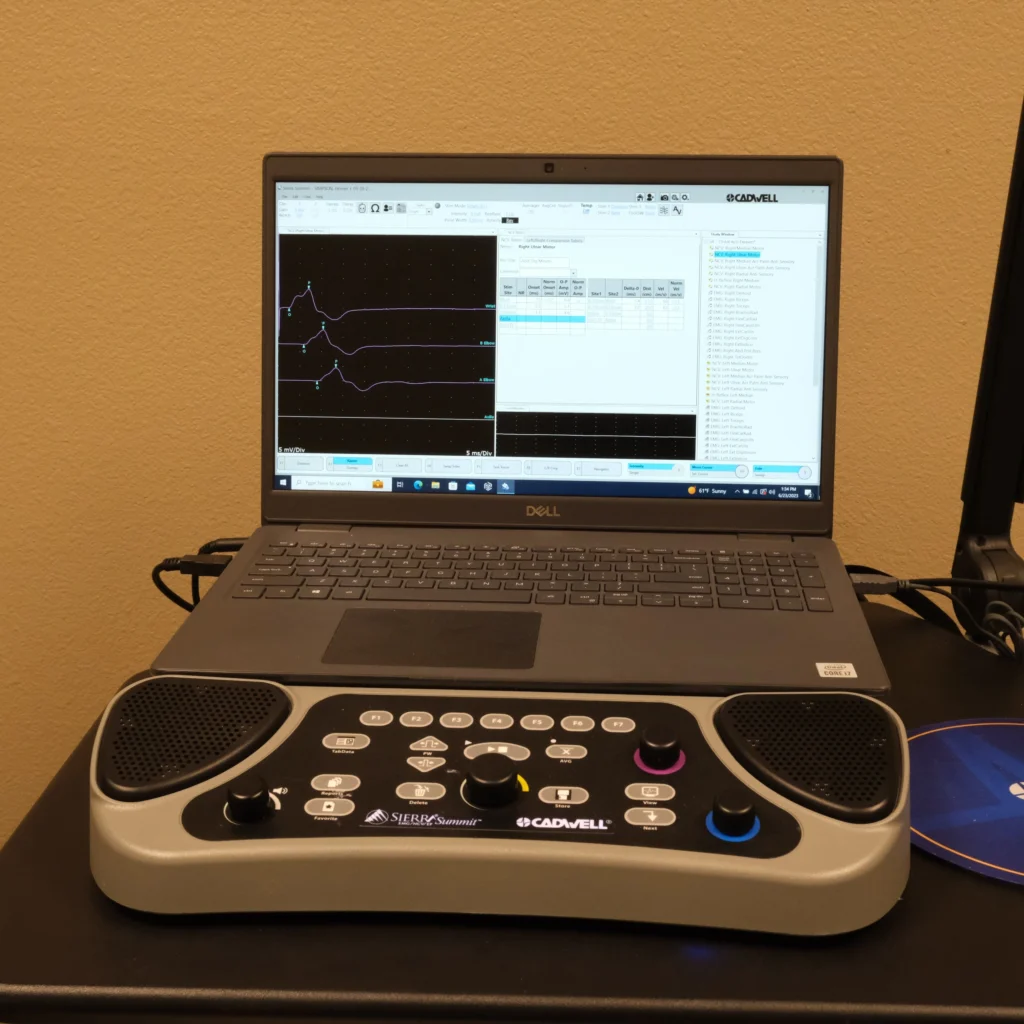
Yes, perhaps, depending on the positioning required to access your arms and/or legs for testing, and as per your comfort level, your doctor may allow you to watch the test screen monitor and explain the EMG procedure to you as it is being performed.
You should be tested if you are experiencing significant pain radiating from the neck or back to the arms or legs, or any symptoms of numbness, tingling, weakness or excessive muscle twitches and spasms.
EDX testing can determine if nerve roots exiting from the spinal canal in the neck or the back are irritated or injured, and if the muscles innervated by these nerve roots show signs of denervation that may be associated with muscle weakness, dysfunction, or nerve-related pain.
EDX testing is often recommended to rule out nerve damage, especially when associated with symptoms of radiating pain, numbness, tingling or weakness.
A disc displacement (bulge, protrusion, herniation) or disc degeneration in the spine may or may not be medically meaningful or functionally impactful on one’s daily life - it depends on one’s anatomy and can differ from case to case. Many but not all spinal disc problems are associated with nerve root irritation. The possibility of any clinically relevant nerve impingement or compression should be investigated. EDX testing may help in determining whether or not the displaced disc material is damaging the adjacent nerve roots at a particular spinal level. The necessity of EDX testing should be determined by your consulting physician.
It usually takes about 2 weeks after nerve injury for diagnostic findings to become detectable on EDX testing, although sometimes findings will show up sooner. Often, an insult or injury to muscles or nerves may have been present for some time prior to one’s awareness of associated symptoms.
Electromyography and nerve conduction studies are functional tests that can be performed quickly and easily during a routine physician office consultation, and are a valuable extension to a complete neuromuscular physical examination in revealing signs of nerve damage and muscle irritability.
EDX testing is a minimally invasive procedure, and can test many muscles as warranted in a single session. Graphic nerve conduction data and EMG tracings are interpreted in real-time, and results are usually determined at the time of testing. There are only a few precautions, and minimal preparation is required before the test.

Effective June 1, 2026, Mountain Medical Practice will transition to a fully virtual care model with all appointments conducted via secure telemedicine.
Contact us for additional information and assistance.
(775) 849-3000